
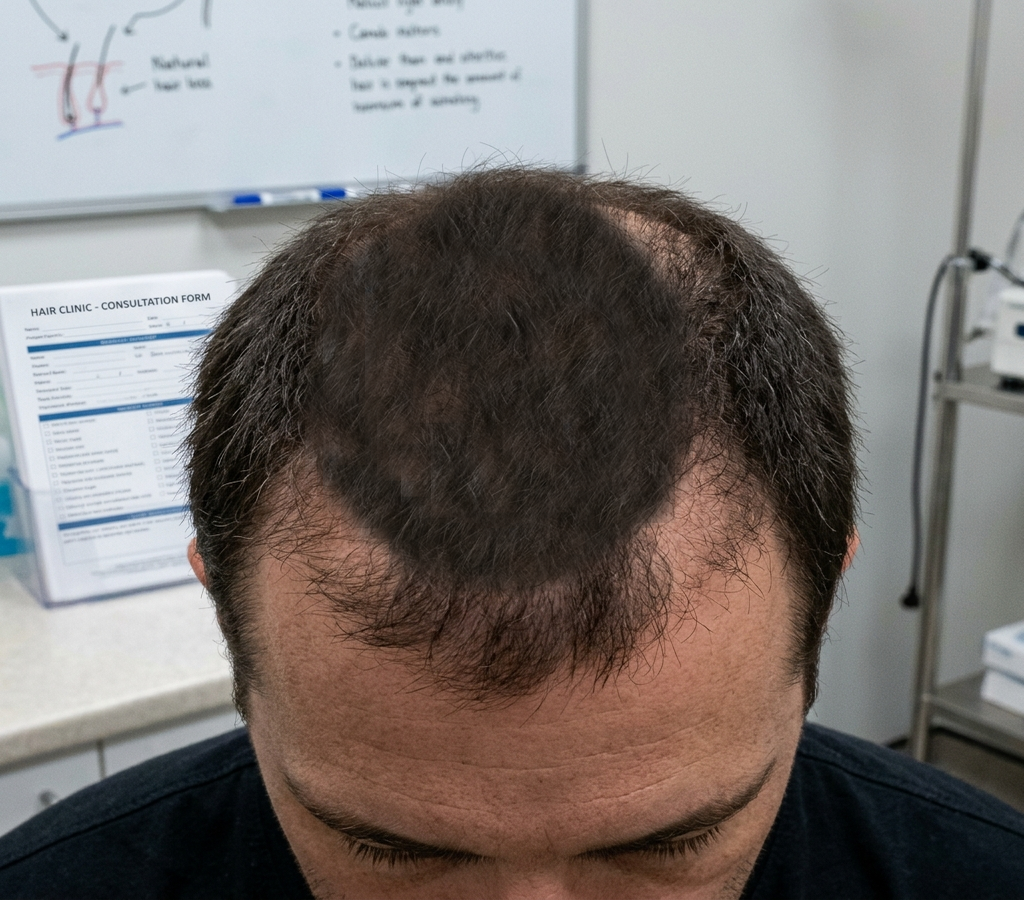
Choosing between Follicular Unit Extraction (FUE) and Follicular Unit Transplantation (FUT) depends heavily on hair density, scalp elasticity, and styling goals. Indian hair types often feature thick, dark strands with robust follicles, making FUE the preferred choice for scarless, high-density results. Learn about graft survival rates and planning.

Before Treatment

After 12 Months (FUE)
Comparing FUE and FUT for Indian Hair
Indian hair is unique; it is typically dark, coarse, and has a slight natural curl or wave, even within the follicle root. This anatomical characteristic requires specialized expertise during extraction to prevent follicle transection. Let’s compare the two primary methods:
| Feature | FUE (Follicular Unit Extraction) | FUT (Follicular Unit Transplantation) |
|---|---|---|
| Incision Type | Individual punch incisions (<1mm diameter) | Linear strip excised from the donor area |
| Scars | Tiny dot scars, virtually invisible even with short hair | Linear scar across the back of the scalp |
| Graft Yield | Excellent, but requires more extraction time | Maximizes donor harvest in a single session |
| Recovery Time | 3 to 5 days; minimal post-op discomfort | 10 to 14 days; requires suture removal |
Why FUE is the Preferred Modern Choice
Modern hair restoration clinics in India have seen a significant shift toward FUE. Because the procedure avoids a linear scar, patients have the flexibility to wear their hair short. Additionally, using micro-punches (0.7mm to 0.9mm) reduces healing time and local swelling. FUE also allows the surgeon to select specific follicular units (e.g., single-hair grafts for the hairline to create a natural transition, and double/triple-hair grafts for the crown to maximize density).
“With Indian hair types, the hair-to-skin contrast is high (dark hair on lighter scalp skin), making hairline design and natural angulation absolutely critical. FUE gives us the precision to select and place each graft with artistic control.”
— Dr. Rajesh Verma, Hair Restoration Specialist
What to Expect from Graft Survival and Planning
Graft survival is heavily dependent on the “out-of-body” time of the follicles. Our clinic uses chilled holding solutions enriched with nutrients to maintain follicle viability during the extraction phase. The average graft survival rate exceeds 95% when performed by experienced teams. A typical high-density restoration requires 2,500 to 4,000 grafts, split over one or two days depending on the degree of alopecia.